Seoul Subway Guide: T-money, Maps, and How to Get Around
If you’re visiting Seoul for the first time and wondering whether the subway is actually manageable — it really is. Seoul’s metro system is one of the most efficient and foreigner-friendly transit networks in the world, and once you’ve done it a couple of times, you’ll find yourself defaulting to it over taxis for almost everything.
This guide covers exactly what you need to know before you board: how to get a T-money card, which lines go where, how to navigate using Korean apps, and the small details that make a real difference on the ground.
AT A GLANCE
🚇 System: Seoul Metro + AREX (Airport Express)⏰ Operating Hours: Approx. 5:30 AM – midnight (varies by line)
💰 Base Fare: ₩1,550 with T-money (as of June 2025)
📱 Recommended App: Naver Map or Kakao Map
🌐 Lines: 9 main lines + several express and regional lines
🔗 Official Info: seoulmetro.co.kr/en
T-money Card: Get This Before Anything Else
The T-money card is a reloadable transit card that works across every subway line, every city bus, and most taxis in Seoul. You genuinely need this — everything else builds on it, and you’ll want it in hand before you even think about which line to take.
You can pick one up at any convenience store near or inside a subway station. CU, GS25, 7-Eleven, and emart24 all carry them. The card itself costs around 2,500–4,000 won (KRW, Korea’s currency — roughly $2–3 USD) and you can pay for it with a credit card. That said, recharging it is cash only — credit cards aren’t accepted for top-ups. It’s a quirk of Korean financial regulations.
For a few days of sightseeing, 20,000–30,000 won is a comfortable starting amount. As of June 2025, the base fare per ride is 1,550 won, with a small distance surcharge added for trips beyond 10km — but most journeys within central Seoul will come to the base fare or close to it.
One thing worth knowing: T-money isn’t linked to your identity in any way. If you lose the card, the remaining balance goes with it. Keep it in the same spot every time — treat it like your wallet.
Reading the Subway Map (It’s Simpler Than It Looks)
The Seoul subway map has nine main lines, dozens of transfer stations, and several hundred stops — and at first glance, it looks genuinely overwhelming. In practice, though, you’re rarely dealing with more than two or three lines at a time, and the system is designed to be navigated without knowing Korean.
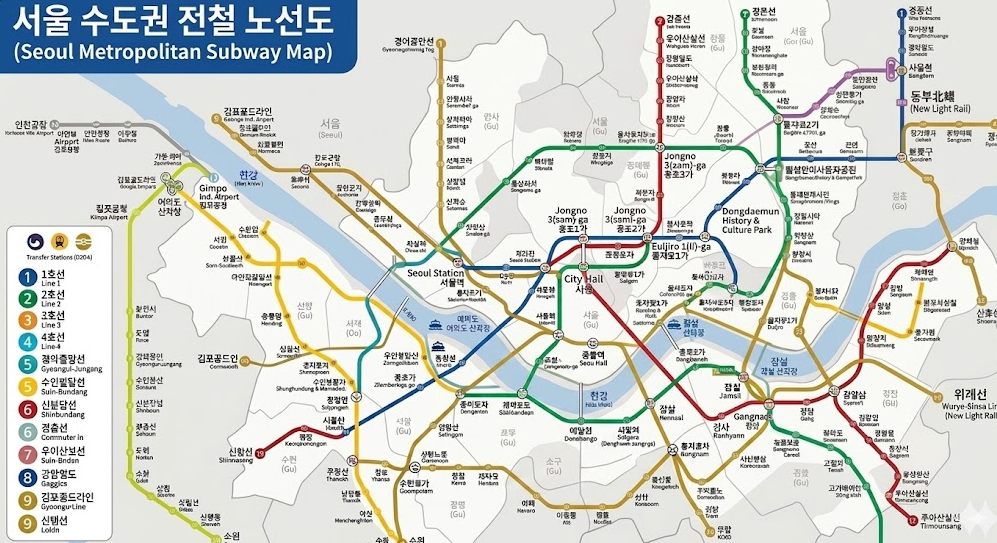
It helps to have the Seoul Metro Map open in another tab while you read through this
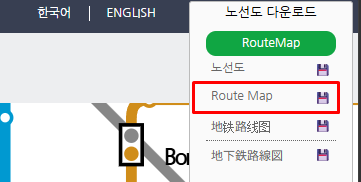
Every line has a number and a distinct color. Every station has its name displayed in both Korean and English, and is also assigned a station number within its line. Hongik University Station on Line 2, for example, is 239. These numbers appear on all in-car displays and platform signs, which makes tracking your position easy even when announcements are hard to follow.
The lines you’re most likely to use as a first-time visitor:
- Line 2 (Green) — the circular line connecting Hongdae, Sinchon, Euljiro, and Gangnam. This is the one you’ll use most.
- Line 3 (Orange) — runs through Gyeongbokgung Palace, Anguk, and Bukchon Hanok Village
- Line 4 (Blue) — covers Myeongdong, Seoul Station, and Dongdaemun
- Line 5 (Purple) — useful for Gwanghwamun and Yeouido
- Line 9 (Gold) — an express line between Gimpo Airport and the Gangnam corridor; significantly faster than other lines for that route, but with far fewer stops
That said, there’s no need to memorize any of this before you arrive. A navigation app will handle the routing — what matters is getting a rough sense of how it works.
Use Naver Map or Kakao Map
Google Maps works in Seoul, but for public transit it’s noticeably less reliable than the local alternatives. Naver Map and Kakao Map are both available in English, and they provide a level of detail that Google simply doesn’t — including which specific car to board for the shortest transfer walk (genuinely useful at large stations), real-time arrival information, and exact platform numbers.
Both apps are easy to use: search your destination in English, select the transit routing option, and the app will show you several route options with transfer details, travel time, and cost. Just follow the directions and you’ll be fine.
Download one before you land. And sort out your data situation — SIM card or pocket WiFi — before you head underground, since both apps need a live data connection to work.
How to use them for subway trips:
1. Open Naver Map (or Kakao Map)
2.Tap the search bar and type your destination in English
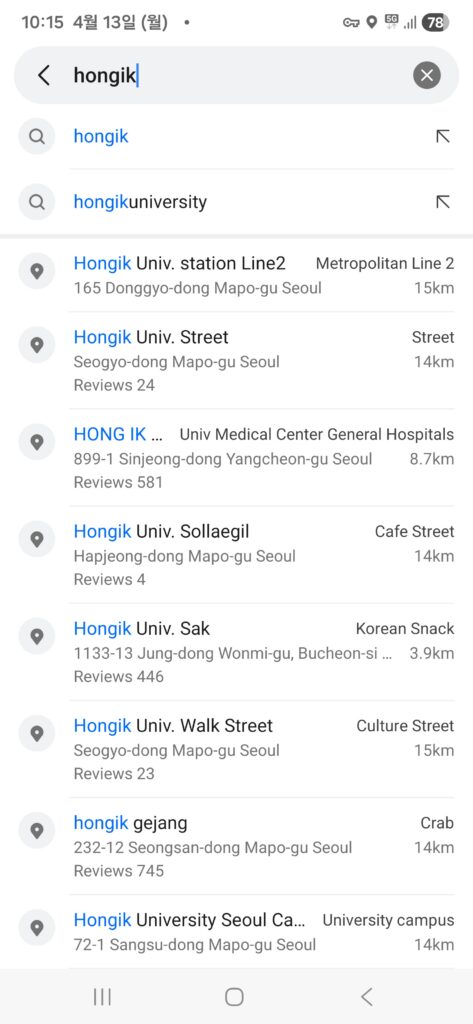
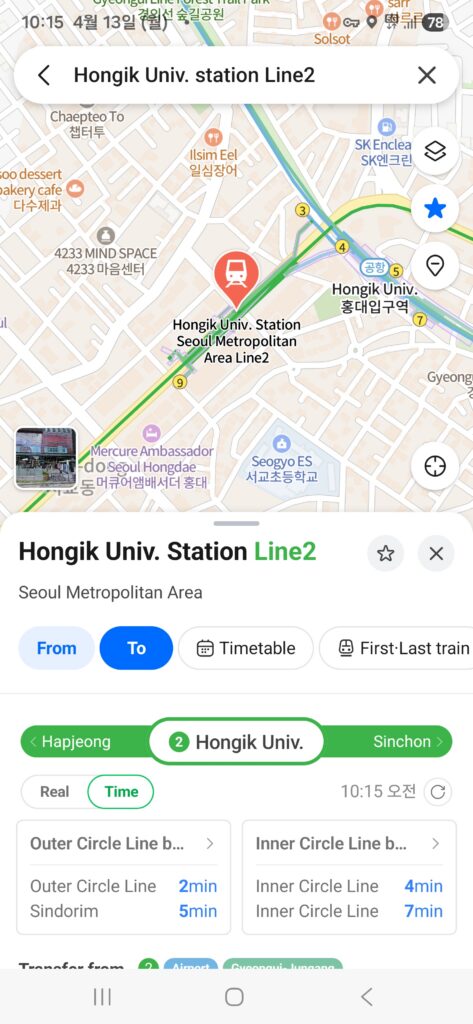
3. Tap the transit icon (bus/train icon)
4. The app shows you multiple route options with travel time, transfers, and cost
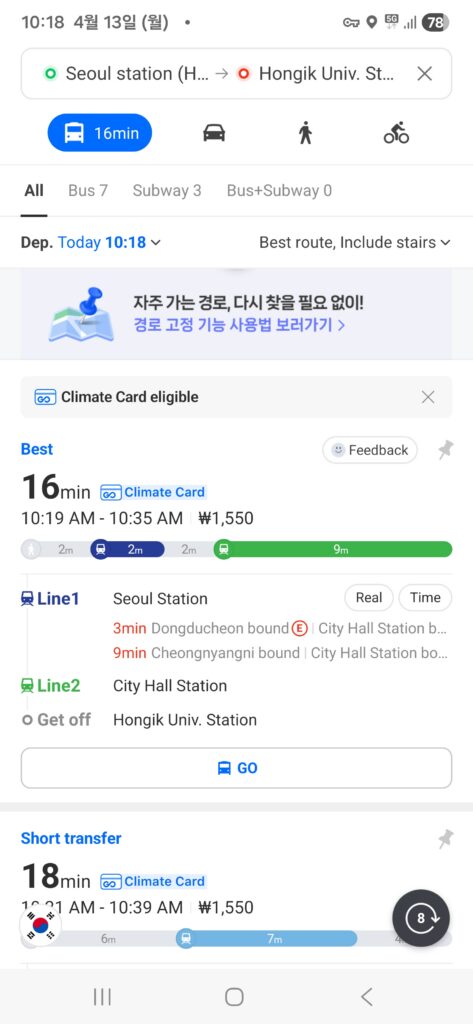
5. Select a route and follow the step-by-step directions
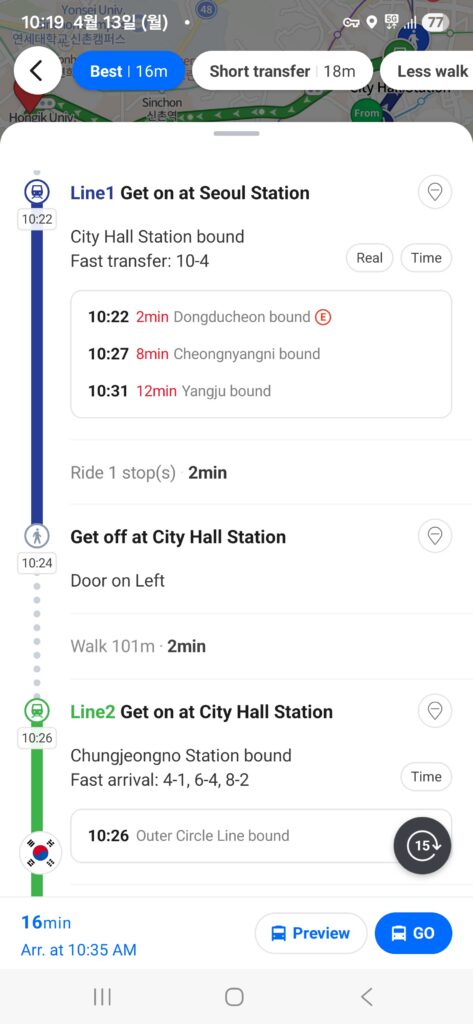
Getting Through the Gates and Onto the Platform
Seoul stations typically have multiple numbered exits, but the exit number only matters when you’re leaving (your app will tell you which one to take). To get in, any entrance works.
At the turnstile, tap your T-money card on the reader. You’ll hear a confirmation beep and the gate opens. If the gate stays closed or you hear a different sound, your balance is probably too low — top it up at the nearest convenience store or charging machine before trying again.
On the platform, the signage shows the direction of travel by listing the terminal station at each end of the line. Your navigation app will tell you which direction you need — just match it up to what’s on the signs. Trains run every two to five minutes during the day, so there’s no need to rush.
Inside the car, a digital display shows the current station, the upcoming stop, and which side the doors will open. Announcements are made in Korean, English, Chinese, and Japanese, so you’ll hear your stop called in English regardless of whether you’re watching the screen.
When you reach your destination, tap your T-money card again at the exit turnstile. The fare is calculated based on total distance traveled and deducted at this point — not when you board.
Transferring Between Lines
Seoul’s public transit runs on an integrated fare system — meaning your subway and bus rides within a single journey are treated as one continuous trip, not separate fares. As long as you transfer within the time limit, you won’t be charged a new base fare each time you switch vehicles. What you pay in total comes down to how far you’ve actually traveled, which makes getting around significantly cheaper than paying per ride.
The transfer discount applies across all combinations — subway to subway, subway to bus, bus to bus — as long as you board the next vehicle within 30 minutes of tapping out of the previous one (60 minutes between 9 PM and 7 AM the next day). Up to 4 transfers are covered per journey, so a multi-leg trip still charges just the base fare plus any distance surcharge.
Subway to subway within the same station: You don’t need to tap out and back in — just follow the transfer signs to your next platform. The time window still applies, so don’t linger too long mid-transfer.
Subway to bus (or vice versa): Tap out of the subway, then board the bus within 30 minutes. Make sure to tap both on and off at every leg — if you forget to tap out of a bus, the transfer discount breaks and you’ll be charged a new base fare for the next ride.
Transfer signs inside stations are color-coded and clearly posted. At most stations the walk between platforms is short, but at major hubs — Express Bus Terminal, Dongdaemun History & Culture Park, City Hall — the corridors can stretch longer than expected. If you’re on a tight schedule at one of these stations, factor in a few extra minutes.
What No One Tells You: Small But Useful Details
Priority seating is not a suggestion. The seats at both ends of every car — often marked in pink — are reserved for elderly passengers, pregnant women, and people with disabilities. In Korea these are taken seriously — people will stand through a packed commute rather than sit there. Leave them empty.
The subway is quiet. Koreans generally don’t talk loudly on the train, and taking phone calls in the car is considered inconsiderate. Keep your voice low and use headphones for audio.
Wait for passengers to exit before boarding. There are marked queuing lines on the platform on either side of each door. Everyone waits, passengers exit first, then boarding happens. It moves faster than you’d think.
The subway stops before midnight. Last trains run between approximately 11:30 PM and midnight depending on the line and direction. If you’re staying out late, plan for a taxi or Kakao T (Korea’s equivalent of Uber) to get back. Keep that in mind when you’re planning a late night out.
Luggage storage is available. Larger stations near transport hubs have coin-operated lockers (물품보관함) — useful if you’re arriving with a suitcase and need to get around before checking in.
What It Costs
A standard adult fare within Seoul is 1,550 won with T-money (as of June 2025). Trips beyond the 10km base range add 100 won per additional 5km — but the vast majority of sightseeing trips within the city will come to the base fare.
Paying with a single-use cash ticket costs 1,650 won, plus a refundable 500 won deposit returned at machines near the exit. It does the job, but T-money is just easier — and the transfer discount alone makes it worth getting.
For the airport connection, AREX runs two distinct services. The All-Stop train takes around 60 minutes from Incheon Airport to Seoul Station, makes stops at Hongdae and Gimpo Airport along the way, and accepts T-money like any other subway ride. The Express train makes the same journey non-stop in 43 minutes but costs 13,000 won and requires a separate ticket purchased at the airport — T-money doesn’t cover it. For most travelers, the All-Stop is perfectly adequate and saves you the trouble of buying a separate ticket when you’ve just landed.
For the full AREX route map, check the official AREX website.
Verdict
Seoul’s subway is, genuinely, one of the best things about getting around this city. It’s fast, clean, inexpensive, and covers virtually everywhere a visitor would want to go. You’ll figure it out within a ride or two — after that, navigating it becomes second nature.
The only real adjustment is reading the directional signage on your first few trips, particularly at larger transfer stations. Give it a ride or two, and it clicks.
FAQ
Q: Do I need a Korean SIM card to use the navigation apps?
A: Both Naver Map and Kakao Map will work on WiFi, so a SIM card isn’t strictly required. That said, having a data connection makes real-time navigation significantly smoother — especially underground where WiFi can be unreliable. Short-term SIM cards are available at the airport at convenience stores and kiosks, or you can rent a pocket WiFi device before you leave arrivals.
Q: What happens if my T-money card runs out mid-trip?
A: The exit gate won’t open — it’ll flash red and you won’t be able to get through. Look for a T-money charging machine inside the station near the gates, top up with cash, and then tap out. (If the only charging machine is outside the gates, you won’t be able to reach it on your own — in that case, press the help button at the gate or flag down a station attendant, who can assist you through.) It’s worth keeping at least 5,000 won on the card at all times to avoid getting stuck at the gate.
Q: What’s the difference between Line 9 local and express trains?
A: Line 9 runs both local (완행) and express (급행) services on the same track. The express skips most stops and is considerably faster — the right choice if you’re heading between Gimpo Airport and the Gangnam area. Check the in-car display when you board to confirm which service you’re on.
Q: Is the subway accessible for wheelchair users or strollers?
A: Most stations have elevators, and newer stations are fully accessible. Some older stations are more limited. Naver Map has an accessibility routing filter that can help plan a route avoiding stairs if needed.
Seoul’s subway is the kind of infrastructure that makes a city feel genuinely livable — and as a visitor, it puts an enormous amount of the city within easy reach. Load up a T-money card, download Naver Map, and you’ll have no trouble getting around from day one.
If you’re still figuring out your Seoul itinerary, check out our guide to Everland’s Tulip Festival — one of the best day trips from the city in spring, and very much accessible by subway and bus.